Planets without suns: searching for the Milky Way’s cosmic wanderers

Not every planet has a star to call home. Some may wander through the Galaxy alone — and finding them is one of astronomy’s currently most intriguing challenges.
When we think of planets, we usually imagine worlds orbiting stars, just like Earth orbits the Sun. But the Universe may be home to a much stranger population: planets that travel through space without a parent star.
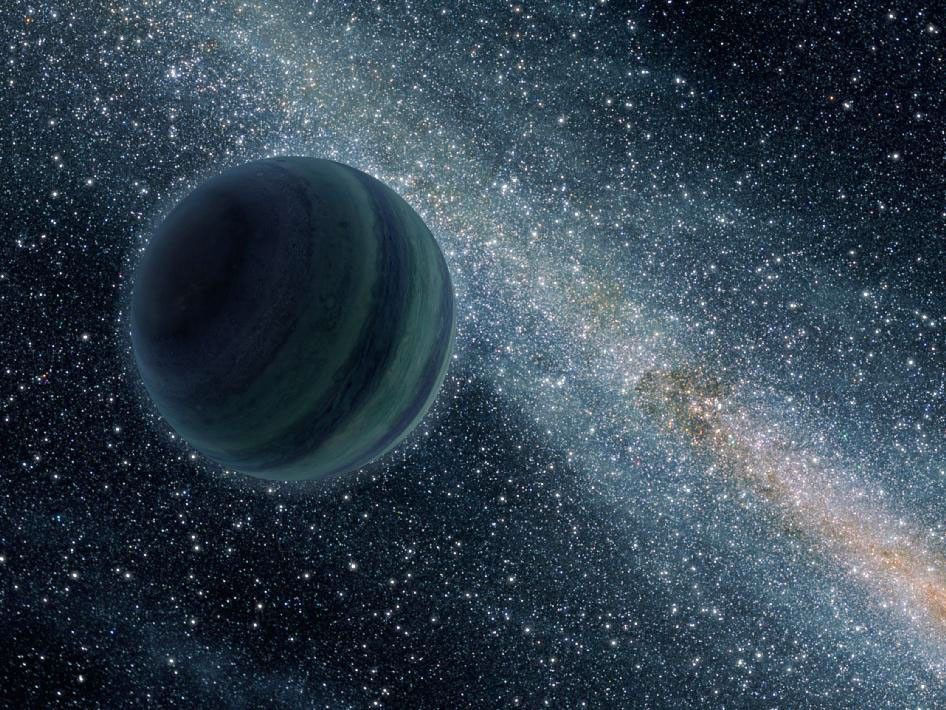
These mysterious objects are known as free-floating planets (FFPs), sometimes called rogue planets. Once an elusive curiosity, they are now attracting growing attention in astrophysics, as new observational techniques and increasingly sensitive instruments open exciting possibilities for their discovery. And they raise a fascinating question: how does a planet end up wandering through the Galaxy alone?
Our new study (led by Raquel San Andrés Navarro, based on her MSc thesis, and co-authored by Isabel Rebollido and myself), recently published in Research Notes of the American Astronomical Society (RNAAS), contributes to this search by identifying 296 free-floating planet candidates across 18 regions.
A planet without a sunrise?
Imagine standing on a planet where the Sun never rises. There are no familiar days or seasons, and no nearby star illuminating the sky. That is the intriguing possibility offered by free-floating planets!
Unlike Earth, Jupiter, or the thousands of exoplanets discovered around other stars, FFPs are objects of planetary mass that are not gravitationally bound to a star.
But how do they come to exist?
Astronomers are exploring two main possibilities:
a) Some may have been kicked out of their planetary systems. Young planetary systems can be chaotic places. Gravitational interactions between planets, or encounters with passing stars, can send a planet flying into interstellar space.
b) Others may have formed on their own. Just as stars form when clouds of gas and dust collapse under gravity, sufficiently small fragments of these clouds might produce isolated objects with planetary masses.
These scenarios tell very different stories about how planets form and evolve. Discovering and studying FFPs could therefore help astronomers understand not only these lonely worlds, but also the history of planetary systems throughout our Galaxy.
Hunting for invisible wanderers
Finding a planet around a star is already challenging. Finding one without a star is even harder.
Planets do not usually produce enough visible light to be easily detected. Most exoplanet searches rely on their effects on parent stars; for example, the tiny dimming caused when a planet passes in front of its star.
For free-floating planets, that familiar strategy does not work.
Fortunately, very young planetary-mass objects can still retain heat from their formation. That makes them potentially detectable, especially at infrared wavelengths.
By searching regions where stars and planetary systems form, astronomers can look for faint sources whose properties are consistent with those expected for young, planetary-mass objects.
The challenge is distinguishing genuine FFPs from other faint astronomical sources. Finding a promising candidate is only the beginning: confirming its nature requires further investigation.
The search is gaining momentum. NASA's recently launched Nancy Grace Roman Space Telescope is expected to revolutionise the study of free-floating planets, potentially discovering hundreds of these elusive worlds through gravitational microlensing. Our study contributes to this rapidly developing field by exploring the potential of Roman's observations, demonstrating its potential to characterise large samples of FFP candidates and helping prepare the ground for a new era of planetary exploration.
296 candidates, 18 regions, countless questions
In our newly published RNAAS study, Raquel led an investigation that identified 296 potential free-floating planets distributed across 18 regions.
These objects are candidates, not confirmed discoveries. Their properties make them interesting targets for further study, but additional observations and analysis are needed to establish what they really are.
This distinction is important. Astronomy often progresses by identifying promising objects, building catalogues, and then using increasingly detailed observations to test their nature.
The new sample offers a starting point for future investigations into where free-floating planetary-mass objects are found, how they form, and how common they might be.
Ultimately, understanding these objects could reveal whether planetary systems frequently lose their planets; or whether nature can create planet-sized worlds without stars at all.
Why does this matter?
Free-floating planets are more than astronomical curiosities. They offer a unique opportunity to test our understanding of how planetary systems form, evolve, and sometimes fall apart.
Their abundance and distribution across the Galaxy could help astronomers distinguish between competing formation scenarios. Are these worlds predominantly planets expelled from their birth systems, or can objects of planetary mass commonly form in isolation? Answering this question could reshape our understanding of planetary formation itself.
Understanding these hidden populations of planets could fundamentally change our picture of the Milky Way, revealing that the planetary worlds we see around stars may be only part of the story.
A first step into a much larger Universe
This publication marks an exciting milestone for Raquel San Andrés Navarro, who led the research as part of her MSc thesis, working alongside Isabel Rebollido and myself. By assembling a catalogue of promising candidates and making it publicly available, her work provides a valuable resource for future investigations. It also demonstrates how student-led research can make meaningful contributions to some of the most exciting emerging questions in astrophysics.
There is still much to learn about free-floating planets. Some may be refugees from distant planetary systems; others may have been born alone. Their origins remain an open question.
But every new candidate brings us closer to understanding the diversity of worlds inhabiting our Galaxy.
After all, the planets we see orbiting stars may be just the tip of a much larger cosmic iceberg.
Read the research: Our paper in Research Notes of the American Astronomical Society.
Explore the data: Raquel's catalogue of free-floating planet candidates is publicly available on Zenodo.

Comments